Tripjyada CMS Staging

Category: Uncategorized

  • How to Plan a Sikkim Darjeeling Tour from Gujarat?

    If you are from Gujarat and want to swap the flight highways with winding Himalayan roads, then you will be making one of the best travel decisions of your life. The day you were sipping chai in Ahmedabad’s 42°C heat, and 48 hours later you found yourselves wrapped in a shawl, watching the sunrise and witnessing the majestic view of the entire Kanchenjunga range turn pink. This is the reason why a Sikkim-Darjeeling tour from Gujarat has become such a favourite among Gujarati families, honeymooners, and senior citizen groups.

    But here’s the thing, Sikkim and Darjeeling are not a “book tickets and figure it out later” type of destination. The distance is nearly 2,400 km, the hilly roads are quite slow, permits might be involved if your timing is wrong, and clouds will politely hide every mountain you came to see. Therefore, this guide covers everything, how to get there, when to go, what a good itinerary looks like, what to eat, and what a Sikkim-Darjeeling tour package from Ahmedabad or from any corner of Ahmedabad actually costs in 2026. Let us plan this properly together.

    How to Reach Sikkim and Darjeeling from Gujarat

    There is no direct flight from Gujarat to the hills, so every Sikkim-Darjeeling tour from Gujarat follows a two-step journey. The gateway to these beautiful hill destinations is the Siliguri Corridor in West Bengal. Siliguri has two entry points, Bagdogra Airport (IXB) and New Jalpaiguri Railway Station (NJP), from which cabs climb into the mountains.

    If you are planning to fly from Ahmedabad, Surat, Vadodara, or Rajkot to Bagdogra, you will usually get a one-stop in Delhi or Kolkata. The total travel time is 5-7 hours, and round-trip fares range from ₹9,000 to ₹16,000 per person if you book it 45-60 days in advance, and if you leave it for the last two weeks, ₹22,000. It takes 3 hours from Bagdogra to reach Darjeeling, the distance is 70 km, but the hill kilometres are a different species, and Gangtok is about 4.5 hours away, where you get to see the gorgeous Teesta River alongside.

    Travelling by train is considered a budget-friendly option, there are trains from Ahmedabad to NJP, direct or via Howrah/Delhi, which take 32-40 hours. The sleeper fares start from ₹800, and 3AC costs around ₹2,200, which makes it very reasonable for large family groups, but the only thing that sometimes makes it a second option for most people is that it takes two days each way. It becomes a great option for travellers who treat the train ride as part of the holiday, so all you need to pack are your theplas accordingly, which are practically invented for this journey.

    There is another alternative option that no one talks about, flying from Ahmedabad to Kolkata, as there can be many cheap direct flights, where you can explore the city and then take an overnight train to NJP. You do a split journey and add a bonus destination, this often saves you ₹3,000-₹4,000 per person.

    A pro tip that you can consider is that whatever you choose, make sure to reach Bagdogra and NJP before noon. This is because the hill roads of both Darjeeling and Sikkim, after dark, are slow, sometimes foggy, and no fun after a long journey, and most drivers refuse to start that Gangtok climb after 5 P.M.

    Best Time to Visit Sikkim and Darjeeling

    For any holiday planning, timing makes or breaks the trip, but here is the honest picture:

    • March to May: During this season, you get to see mesmerising natural scenery of rhododendrons and magnolias. As the temperature stays between 10 and 20°C, you get to see clear openings. It becomes a peak season for Gujarati travellers, who want to escape the summer heat. Therefore, the hotels fill up 2 months in advance.
    • October to December: This period is considered to be the best time for mountain views because the post-monsoon skies are washed clean, making the air crisp and making Kanchenjunga clearly visible almost every day. During December, it adds snow at Tsomgo Lake and Nathula, so it is advised to bring heavy woollens.
    • June to September: It is the most risky season for travellers because during this time there is heavy rainfall that takes place in this region, it causes landslides, blocked highways, leeches on trekking trails, and zero visibility. Even if the hills remain green during this time, you will still see them mostly fogged.
    • January to February: If you are someone who loves chilly weather or snow, this season can be very suitable for you because during this time the temperature can touch as low as 1-2°C, even the viewpoints remain empty, and hotel rates come down as it is the off-season. 


    For many travellers around the nation, April-May and October-November hit the sweet spot between weather, views, and vacation calendars.

    A Tried-and-Tested 7-Day Itinerary

    Most of the travellers have already done this circuit in 6-8 days. Here is a 7-day plan that does not feel like a school tour.

    • Day 1: Arrive at Bagdogra/NJP and then drive straight to Gangtok, which will take around 4.5 hours. Once you check in to the hotel, you can head to MG Marg after a short nap to witness its spotless environment and traffic-free promenade. You can also have the authentic momos from some locally recommended stalls or cafes and savour them while you watch the world go by.
    • Day 2: The next day, you will move on to sightseeing near Gangtok, where you will visit famous attractions like Rumtek Monastery, Banjhakri Falls, and Ganesh Tok viewpoint and also enjoy the thrilling ropeway ride over the city. In the evening, you can also visit the local bazaar for shopping and then come back to the hotel for an overnight stay.
    • Day 3: You wake up and prepare for a big day as you will move ahead for a full-day excursion to Tsomgo Lake, which is situated at 12,400 ft. After that, you will move to Bab Harbhajan Singh Mandir, you can also add Nathula Pass, where you can stand at the Indian China border and learn about the historic wars that took place out there. You can also enjoy yak rides at Nathula Pass, which cost between ₹ 300 and ₹ 500, and click pictures with your loved ones.
    • Day 4: On this day, you will move to Darjeeling from Gangtok, and the time duration of your journey will take approximately 4 hours. On the way, you can stop at the Teesta-Rangeet river confluence and enjoy the breathtaking view of the mountains. In the evening, once you reach Darjeeling, you can take a stroll on Mall Road and Chowrasta and then enjoy a hot cup of exotic tea at Glenary’s.
    • Day 5: You will wake up at 4 a.m. to see the most famous Tiger Hill sunrise. At that time, you will be experiencing chilly and cold weather but still encounter a crowd. It will be worth every yawn as the Kanchenjunga catches fire in gold. Then move to Batasia Loop, Ghoom Monastery, and then the UNESCO-listed Toy Train joyride.
    • Day 6: This day will be quite slow and calm, where you use the day to visit the famous tea garden of Darjeeling and then visit the Himalayan Mountaineering Institute, Padmaja Naidu Zoo, and the Peace Pagoda.
    • Day 7: Your beautiful journey comes to an end as you move back to Siliguri to reach Bagdogra/NJP, the whole journey might take around 3 hours.


    If you have an extra 2-3 days, you can also add peeling for the glass skywalk and the closest view of Kanchenjunga or go north to Lachung and Yumthang Valley, Sikkim’s “Valley of Flowers”, which is carpeted with blooms every April and buried in snow come December. North Sikkim requires an additional permit and a different vehicle, so it must be booked as an add-on and cannot be decided upon at the moment.

    Permits and Documents You’ll Need

    There is no need for a permit for an Indian citizen to visit Gangtok or Darjeeling, but when it comes to border areas, like Tsomgo Lake, Nathula Pass, and all of North Sikkim, a protected area permit is required, which is issued only through registered local tour operators, therefore, you need to carry the following:

    • Aadhaar card or voter ID
    • 6-8 passport-size photographs
    • Photocopies of your ID for each permit application.


    The Nathula Pass is on a quota system and closed on Mon and Tue, so block out that day of your itinerary first. If you book a Sikkim-Darjeeling tour package from Ahmedabad, the operator takes care of every permit – honestly one of the biggest reasons packages beat DIY planning here.

    Travel Tips for Gujarati Tourists Visiting Sikkim Darjeeling

    This is where most of the guides go generic, but here’s what actually matters when you are heading out on a Sikkim Darjeeling tour from Gujarat.

    Food is simpler than you think. Both Gantok’s MG Marg and Darjeeling’s Mall Road have pure vegetarian and Jain-friendly restaurants, and you’ll also find Gujarati and Marwari eateries. Worth trying at least once are veg momos, thukpa, and glass noodle soups from Darjeeling. Options shrink very fast when you visit North Sikkim, so it is advised to pack khakhra, thepla, chevdo and instant poha for excursion days. Most hotels will make simple dal cahwal sabzi to order if you give them a day’s notice.

    Layer up but do not bulk up. Even if it is the month of May, Tsomgo Lake can be freezing while Gangtok may feel pleasant. Carry thermals, a windproof jacket, gloves, and a woollen cap instead of one giant sweater. You can also rent snow boots and overcoats for ₹100-₹200 if by any means you are caught off guard.

    Do not underestimate the altitude. Tsomgo, Nathula and Yumthang are above 12000 ft. Take it slow, drink plenty of water, have no alcohol the night before, and have Diamox ready after talking to your doctor—very important for the dada-dadis in the group. If you feel dizzy or nauseous, come down; don’t try to power through. 

    Hindi works everywhere. Language is never an issue, as the locals in Sikkim and Darjeeling speak Hindi fluently. A warm ‘Namaste’ or Sikkimese ‘Tashi Delek’ brings instant smiles.

    Money is the hills’ lifeblood. Outside Gangtok and Darjeeling, ATMs are few and far between, and card machines are a rarity at high-altitude stalls and yak-ride counters. Carry ₹10,000–₹15,000 cash per couple. UPI works in the towns but dies with the network on outskirt roads.

    Roads test your stomach, not your patience. The drives are spectacular but relentlessly winding. If anyone gets motion sickness, carry Avomine, sit in the front seat, and keep lemon or elaichi useful. Also build in buffer time – a “4 hour drive” happily becomes 6 with rain, traffic, or an army convoy.

    Pre-book the toy train and permits. The Darjeeling toy train joyride is fully booked on the IRCTC website days ahead during April-May and Diwali holidays. Nathula too runs out quickly in peak season. Book them both before you leave Gujarat.

    Shopping that is worth your suitcase space, Darjeeling tea from an estate (₹400-₹2,000 per 100g depending on flush), Sikkimese prayer flags, hand-knitted woollens from Lall Market, and Temi tea from Sikkim’s only tea garden.
    Sikkim Darjeeling Tour Package Cost from Ahmedabad

    Now the question every Gujarati planner asks first is, ‘What’s the damage?’ The Sikkim-Darjeeling tour package cost from Ahmedabad depends on three things — trip length, hotel category, and whether flights are included. Here’s a realistic 2026 breakdown per person on twin sharing:

    Package Type 

    Duration 

    Land Package Only 

    With Flights

    Budget (2–3 star hotels) 

    5N/6D 

    ₹16,000–₹22,000 

    ₹28,000–₹35,000 

    Standard (3-star + good transfers) 

    6N/7D 

    ₹24,000–₹32,000 

    ₹36,000–₹45,000 

    Deluxe (4-star, private cab) 

    6N/7D 

    ₹30,000–₹40,000 

    ₹45,000–₹50,000 

    Honeymoon special 

    6N/7D 

    ₹25,000–₹32,000 

    ₹35,000–₹40,000 

    Usually Included: Hotels on a B&B & dinner basis, private/shared transfers from Bagdogra/NJP, sightseeing as per the itinerary, all standard permits, driver allowances, and tolls.

    What is NOT generally included: Lunches, Nathula Pass permit (Extra ₹3,000-5,000 per vehicle), ropeway and toy train tickets, and entry fees at monuments. Personal expenses and North Sikkim add-ons (Lachung/Yumthang) normally cost an additional ₹8,000–₹12,000 per person for 2 nights. 

    Money-saving tips: 

    • Travel in a group of 6+ — a shared Innova or Xylo cuts per-head transport costs dramatically. Travel in a group of 6+ — a shared Innova or Xylo cuts per-head transport costs dramatically.
    • Book your Sikkim-Darjeeling tour package from Ahmedabad 60-90 days in advance to get the best price on the flight component.
    • In the shoulder-season periods of late September or early March, the same hotels give 15–20% discounts. In the shoulder-season periods of late September or early March, the same hotels give 15–20% discounts.
    • Compare at least three operators. Get ‘sightseeing included’ in writing. The cheapest quote often quietly excludes Tsomgo Lake as a ‘payable extra’. Compare at least three operators. Get ‘sightseeing included’ in writing. The cheapest quote often quietly excludes Tsomgo Lake as a ‘payable extra.’


    A well-planned trip for 7 days, including the flight from Ahmedabad, can cost a couple around ₹80,000 to ₹1,10,000 in total. Like a good trip to Kerala or Rajasthan, but with the third-highest mountain on earth behind you.

    Final Word

    If you are planning a Sikkim Darjeeling tour from Gujarat, there are three smart moves you should make: Book your flights to Bagdogra 60+ days in advance. Travel in spring or post-monsoon autumn. Let a reliable operator handle the permits and hill logistics. Do that, and all that remains is the fun bit, steaming momos on MG Marg, the whistle of a 140-year-old toy train, and that first jaw-dropping view of Kanchenjunga at sunrise. Gujarat has whetted your appetite for travel, the Himalayas are more than ready to satiate it.
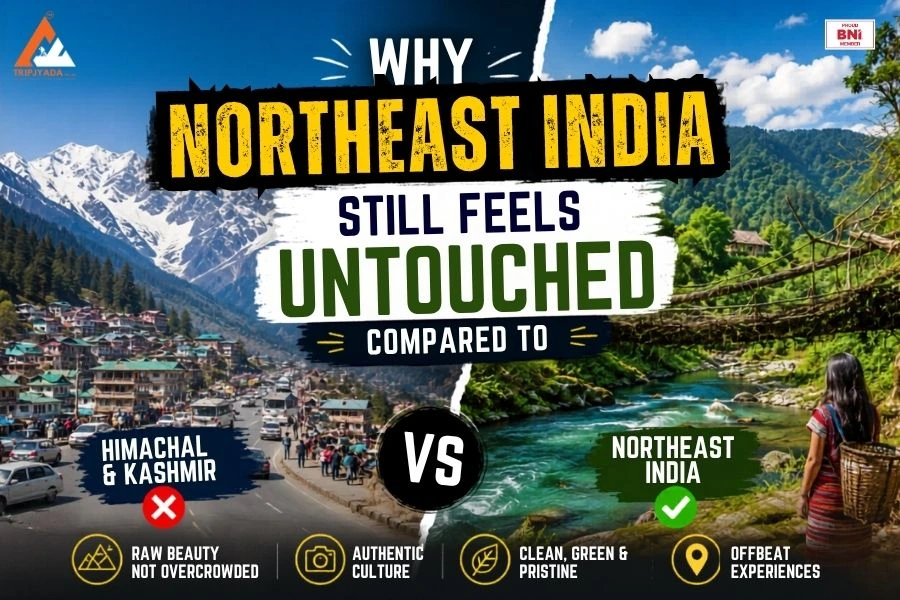

  • Why Northeast India Still Feels Untouched Compared to Himachal & Kashmir

    Why Travelers Are Now Looking Beyond Himachal & Kashmir

    For years, destinations like Himachal Pradesh and Kashmir have dominated Indian travel bucket lists. From crowded cafes in Manali to packed tourist spots in Gulmarg, these places continue to attract massive numbers of travelers every season.

    But in 2026, a different side of India is quietly capturing the hearts of travelers – Untouched destinations of Northeast India are now becoming the top choice for travelers who want peace, nature, and authenticity away from crowded tourist spots like Himachal and Kashmir.

    Unlike many mainstream hill destinations, Northeast India still feels raw, peaceful, and deeply connected to nature. The roads are quieter, the mountains feel more personal, and the experiences are far more authentic. Instead of crowded viewpoints and traffic jams, you find hidden waterfalls, mist-covered valleys, local cultures, and landscapes that still feel untouched.

    That is exactly why travelers searching for unexplored places in India are now choosing the Northeast over crowded tourist circuits.

    What Makes Northeast India Feel So Untouched?

    The biggest difference is simple — mass tourism has still not completely taken over Northeast India.

    While places like Shimla, Manali, and Srinagar often feel commercialized during peak seasons, destinations in the Northeast continue to preserve their natural beauty and cultural identity.

    In Northeast India, you still experience:

    • Quiet mountain roads without endless traffic
    • Clean air and peaceful surroundings
    • Authentic local food and traditions
    • Less crowded sightseeing spots
    • Hidden villages and unexplored landscapes
    • Genuine hospitality from locals

    The region offers something modern travelers are desperately searching for — peace.

    Sikkim – Where Mountains Still Feel Pure

    Sikkim is one of the most beautiful untouched destinations of Northeast India, offering clean landscapes, monasteries, and peaceful mountain experiences.

    Whether it’s the peaceful monasteries of Ravangla, the lively streets of Gangtok, the snowy beauty of North Sikkim, or the calm landscapes of Pelling, Sikkim gives travelers a perfect blend of adventure, culture, and relaxation.

    Unlike overcrowded hill stations, Sikkim still feels organized, clean, and naturally beautiful.

    June is one of the best times to experience:

    • Cloud-covered valleys
    • Green mountain landscapes
    • Fresh waterfalls
    • Pleasant weather
    • Peaceful road trips

    At Tripjyada, we offer customized Sikkim tour packages designed for families, couples, groups, and corporate travelers.

    Darjeeling – More Than Just a Hill Station

    Darjeeling is often compared with other popular hill destinations, but the charm here feels completely different.

    The slow mornings, tea gardens, toy train rides, Kanchenjunga views, and old colonial atmosphere create an emotional connection that many destinations fail to offer today. Even during busy seasons, Darjeeling still carries a timeless mountain vibe that travelers fall in love with again and again.

    From romantic trips to family vacations, Darjeeling remains one of the most loved mountain destinations in Eastern India.

    Bhutan – The Himalayan Escape Everyone Needs

    If you want mountains without chaos, Bhutan is the perfect answer.

    Bhutan focuses on happiness, sustainability, and peaceful tourism. That’s why travelers returning from Bhutan often describe the experience as calming and life-changing.

    From the monasteries of Paro to the valleys of Punakha and Thimphu, Bhutan offers:

    • Peaceful landscapes
    • Beautiful Himalayan roads
    • Rich Buddhist culture
    • Clean and organized cities
    • Less commercial tourism

    June is also a fantastic season for Bhutan road trips and group tours because the valleys become greener and the weather remains pleasant.

    Tripjyada offers Bhutan group tours and customized Bhutan packages from Bagdogra, Siliguri, and nearby regions.

    Meghalaya – India’s Hidden Paradise

    Meghalaya feels like a destination straight out of a dream. It remains one of the most unique untouched destinations of Northeast India with waterfalls, caves, and living root bridges.

    Unlike mainstream tourist states, Meghalaya still feels fresh and unexplored. Even simple road journeys become unforgettable experiences here.

    Places like:

    • Shillong
    • Cherrapunji
    • Dawki
    • Mawlynnong

    continue to attract travelers looking for nature, peace, and adventure together.

    Arunachal Pradesh – The Last Frontier of Indian Tourism

    If there is one destination that truly defines unexplored India, it is Arunachal Pradesh.

    Massive mountains, remote monasteries, beautiful valleys, and untouched roads make Arunachal feel completely different from mainstream tourism destinations. Tawang especially has become a dream destination for mountain lovers, but the region still remains far less crowded compared to popular northern states.

    For travelers who genuinely want to disconnect from city life, Arunachal offers one of the purest travel experiences in India.

    Why June Is the Best Time to Book Northeast India Tours

    June officially begins one of the busiest travel seasons for Northeast India tourism.

    As schools close and summer vacations continue, demand for:

    • Sikkim tour packages
    • Darjeeling trips
    • Bhutan group tours
    • Meghalaya road trips
    • Arunachal Pradesh tours

    starts increasing rapidly.

    Hotel availability becomes limited, flight prices rise, and premium stays get booked early.

    That’s why early booking is always recommended.

    Booking your trip in advance helps you:

    • Get better hotel choices
    • Secure lower package prices
    • Avoid last-minute availability issues
    • Plan smoother itineraries
    • Enjoy better travel experiences

    Explore Northeast India with Tripjyada

    At Tripjyada, we specialize in curated Northeast India experiences with local expertise, comfortable stays, trusted transportation, and personalized itineraries.

    Whether you are planning:

    • A romantic Sikkim getaway
    • A peaceful Bhutan trip
    • A Meghalaya adventure
    • A Darjeeling family vacation
    • An Arunachal Pradesh road trip

    Our team helps you experience the Northeast as comfortably and authentically as possible.

    Because some places are not just meant to be visited.

    They are meant to be felt.

    Book your Northeast journey early this June with Tripjyada and discover the side of India that still feels untouched.

  • Stop Googling & Start Packing: All-Inclusive Sikkim Tour Checklist

    Are you spending the nights with multiple tabs open, comparing the altitudes of Lachen vs. Lachung to make a perfect Sikkim tour itinerary? We all have been there in the Sikkim tour checklist, and the truth is, the Himalayas don’t care about perfect spreadsheets.

    Sikkim is a land of unpredictable mist, sudden mountain blooms, and the kind of silence that makes you forget about your phone. If you’re planning a tour to Sikkim, it’s time to quit all the tabs, because here is the only Sikkim checklist that you’ll need to bridge the gap between “thinking about it” and actually standing in front of the eastern Himalayas.

    Read More… Sikkim Darjeeling Tour Package: A Perfect 7-Day Travel Plan

    Transit Hacks: Mapping Your Sikkim Tour Checklist Route

    Reaching Sikkim, the “Valley of Rice,” depends entirely on the place from where you’re starting the journey. Travelers mostly choose to fly to Bagdogra (IXB) or directly to Pakyong Airport (PYG). Though Pakyong is Sikkim’s only airport, it can be unreliable at times due to uncertain weather.

    Delhi to Sikkim:

    • Flight: New Delhi (DEL) to Bagdogra (IXB) takes only 3-4 h.
    • Train: New Delhi to NJP, takes 20-24 hrs.

    Mumbai to Sikkim:

    • Flight: Mumbai (BOM) to Bagdogra (IXB), taking 2h 30mn to 3h.
    • Train: Mumbai to Siliguri/NJP, taking almost 1d 12hr.

    Bangalore to Sikkim:

    • Flight: Bangalore (BLR) to Bagdogra (IXB), taking about 3 hrs.
    • Train: Yesvantpur JN/Bangaluru CANT to NJP, almost a 1-day, 21-hour ride.

    Chennai to Sikkim:

    • Flight: Chennai (MAA) to Bagdogra (IXB), only about 3h.
    • Train: Perambur/Chennai CTL to NJP, takes 1d 12h to 1d 14h.

    Trains offer a budget-friendly and scenic journey to Sikkim. You can skip that day-long journey and fly directly and take a smooth cab ride to Sikkim with Northeast Cab, because your safety is our priority.

    Explore… Bhutan Trip Planning 2026: Everything You Need to Prepare

    Ultimate 6 Day Sikkim Tour Checklist Itinerary

    Planning a trip to Sikkim, the land of dawn-lit mountains, requires a balance of timing and geography. While we customize every journey at Tripjyada, here’s what a standard 6-day Sikkim tour itinerary usually looks like.

    Day 1: Arrival

    • Pick up from Bagdogra (IXB)/NJP and drive toward Gangtok with Teesta River views.
    • Hotel check-in and exploring local markets in MG Marg and cafes.
    • Overnight in Gangtok.

    Day 2: Gangtok to Lachen

    • Moving to Lachen through valleys & mountain roads with waterfall views
    • Stopping for the Kanchenjunga view at the Singhik viewpoint & Chungtang.
    • Reaching Lachen for an overnight stay.

    Day 3: Lachen to Lachung

    • Visiting Gurudongmar Lake in the morning before heading for Lachung
    • Feeling the mountain views while reaching Lachung
    • Spending the night at Lachung

    Day 4: Sightseeing

    • Feel nature’s beauty in the famous Yumthang Valley.
    • Enjoy serene river views and seasonal snow at Zero Point.
    • Return to Lachung and spend the night here.

    Day 5: Lachung to Gangtok

    • Driving back to Gangtok on a scenic byway.
    • Stop on the way for photographs.
    • Strolling & shopping in Gangtok and an overnight stay.

    Day 6: Departure

    • Checking out of the hotel.
    • Drive to Bagdogra Airport / NJP for departure.

    Seasonal Sikkim Tour Checklist

    Season  Temperature What to pack 
    Summer (March to June) 10˚C – 25˚C Light cottons for the day. Puffer vest for the evening in Gangtok.
    Monsoon (July to September) 13˚C – 23˚C Waterproof & quick-dry warmers to survive windy mountain rain. Antifungal ointments to keep feet healthy during damp treks.
    Winter (October to February) -5°C to 10°C Heavy thermal base to trap body heat. Small chemical heat packs can be lifesaving. 

    Regardless of the season, keeping a compact medical kit is essential for a Sikkim tour for high-altitude sickness, motion sickness, and any accidental injuries.

    Ready to Start Your Journey With Tripjyada?

    Stop scrolling through endless reviews and start your Sikkim tour with Tripjyada. Let our professionals handle the logistics while you handle the memories in Sikkim. 

    You can check out Sikkim-Darjeeling tourism for a detailed journey through the northeast circuit.

    Book your special Sikkim tour package or contact Tripjyada for a customized Sikkim tour package. Don’t be late to grab the best deal!

    Also Explore… 2026 Travel Checklist: The Must-Visit Places for the Himalayas

    FAQs:

    1. What are the best pilgrimage sites in Sikkim?

    There are many Buddhist pilgrimage sites in Sikkim, like Rumtek Monastery, Baba Mandir, Ganesh Tok, Chardham, etc.

    1. What are the things to do in Sikkim?

    You can explore hidden caves, wildlife sanctuaries, adventure tourism, pilgrimage tourism, and heritage tourism in Sikkim.

    1. Which part of Sikkim is best to visit?

    While all of Sikkim is worth a tour, North Sikkim offers the best views, from blooming valleys to snow & frozen lakes at high altitudes.

    1. What is the best time to visit Sikkim?

    – March to May is best for seeing colorful blooms in Sikkim’s pleasant weather, and October to December for clear views of the Himalayan mountains.

    1. Is a permit required for Indian tourists?

    No permit is needed for Indians, but a PAP is mandatory for visiting border areas like Tsomgo Lake, Nathula Pass, Lachen & Lachung.

    1. What foods to try in Sikkim?

    Authentic Tibetan momos, Gundruk, Sel roti, Laphing, Kinema, Sishnu—these are the must-try dishes in a Sikkim tour.

  • Celebrate Diwali 2025 Differently: Sikkim, Darjeeling or Bhutan?

    As the season of lights approaches, the air in India begins to shimmer with anticipation. Streets twinkle with fairy lights, rows of clay diyas warm homes, and families meet to share sweets, blessings, and laughter. Fireworks glitter in the night sky, symbolising the joy that Diwali provides to everyone’s heart. It’s no surprise that many people want to escape the mundane and celebrate Diwali 2025 in a special, gorgeous, meaningful, and peaceful location.

    For decades, Shimla and Manali have been popular Diwali escapes. Their pine-scented air, historical elegance, and cold November breezes made them perfect retreats. However, in recent years, the tranquillity that formerly marked these hill stations has been replaced by congested streets, noisy crowds, and tourist overkill. Hotels are reserved several months in advance. The roads are congested with continuous traffic. And what should be a relaxing vacation frequently turns into a stressful, pricey event. The once delicate magic now seems loud and commercial.

    Shimla and Manali are indeed stunning. However, during peak holiday seasons, they’ve become too familiar, congested, and rushed. Do you really want to get stranded in a traffic jam on a mountain route when celebrating Diwali in 2025? Or negotiating for space at a popular sunset spot?Diwali celebrates light, clarity, and harmony. So, why follow the throng when you can stay calm?

    Shimla and Manali are indeed stunning. However, during peak holiday seasons, they’ve become too familiar, congested, and rushed. Do you really want to get stranded in a traffic jam on a mountain route when celebrating Diwali in 2025? Or negotiating for space at a popular sunset spot?Diwali celebrates light, clarity, and harmony. So, why follow the throng when you can stay calm?

    What If You Could Celebrate Diwali Differently?

    What if on Diwali 2025, you did something genuinely unique?

    No honking cars. There are no packed hotels. No more dashing through crowds to catch a sight of fireworks.

    Instead, imagine yourself sipping hot tea in the foggy hills of Darjeeling while watching the sun rise over the snow-capped Kanchenjunga. The weather is chilly, the sky is clear, and you can only hear birds and leaves rustling in the breeze.

    Imagine a calm morning in Sikkim, in a quiet village where monks chant softly and prayer flags flutter over historic rooftops. You wake up slowly, feeling the sun’s warmth on your face rather than a blasting alarm or traffic outside your window.

    And then there is Bhutan. You’re wandering along a peaceful riverbank, the air wafting the aroma of pine and incense. The streets are tranquil. The people smile. You breathe softly and deeply for the first time in months.

    This is not a dream. It is real. And it is waiting for you.

    There’s a more peaceful way to celebrate Diwali 2025—in communities that haven’t forgotten how to pause. In places where light does not only flare and vanish, but remains with you long after the festival has over.

    Welcome to Diwali 2025 in Sikkim, Darjeeling, and Bhutan, where the lights not only shine but also calm the spirit.

    Sikkim – Diwali in a Land of Monasteries and Mountains

    Imagine waking up in the slopes of Sikkim on a crisp November morning. The air is cold but pleasant, with notes of pine, incense, and early sunlight. Firecrackers do not wake you up. Instead, you hear a gentle hum of monks singing nearby, soft and constant, like a heartbeat. In this area of the world, Diwali 2025 feels spiritual rather than boisterous.

    The capital, Gangtok, begins to shine as evening descends. However, it does not function in the same way as city streets. Homes here use butter lights, which are little flickers of flame that dance silently. MG Marg sparkles beneath strings of soft fairy lights, as people walk gently, smiling and sipping sweet butter tea. The shops are open, but nobody hurries. There is time. There is space to breathe.

    As darkness sets, you make your way to a lonely hilltop in Pelling. The skies are clear. And in the distance, the towering Kanchenjunga stands guard, its snow-capped peaks capturing the last rays of sunset light. No smog. There’s no turmoil. Only the mountain, the stars, and the mellow glow of Diwali.

    Here, you don’t just celebrate a holiday; you experience it. Sikkim offers a more personal Diwali experience. Gentle. Soulful. It serves as a reminder that light does not need to be loud to be beautiful.

    Celebrate Diwali 2025 the peaceful way with our customised tour packages to Sikkim for soulful getaways beyond the crowds

    Darjeeling – Tea Gardens, Toy Trains, and Tranquility

    Darjeeling in November is like walking into a dream where time moves a little slower. The crowds are gone. The skies become a clear, limitless blue. And on Diwali 2025, this hill town hosts a heartfelt celebration with minimal disturbance.

    Instead of noisy firecrackers, you’ll hear the gentle rustle of trees around Tiger Hill, where mornings begin with the golden glow of the rising sun kissing the snowy Kanchenjunga. Local homes and cafés along Chowrasta and Mall Road illuminate little diyas on their windowsills, providing a soft glow on the cobbled paths below.

    Local markets around Ladenla Road and Batasia Loop sell handcrafted candles, woolen shawls, and homemade treats with a grin. There is warmth in every nook, not from fire, but from people.

    Board the famed Darjeeling Himalayan Railway, a toy train that slowly travels through mist-covered hills and tea estates. The whistle breaks the silence like a melody, and you sit by the window, sipping warm Darjeeling tea while the world outside turns golden.

    Later, take a stroll through the serene grounds of Peace Pagoda, where prayer flags flutter and peace pervades the air. Or visit Happy Valley Tea Estate, where the aroma of fresh tea leaves lingers in the air.

    And at night, Darjeeling glows, not with noise, but with soul. Paper lanterns illuminate the balconies. Laughter floats from silent cafés. And the hills, drenched in moonlight, seem to be celebrating alongside you.

    Celebrate Diwali 2025 with our specially curated Darjeeling tour packages, perfect for couples seeking romance or groups craving a peaceful mountain escape.

    Bhutan – The Ultimate Peaceful Diwali

    Bhutan does not celebrate Diwali in the same way we do—which is why it could be the ideal place to spend it.

    You’re not running away from the festival. You simply choose to reinterpret it. In a world where happiness is defined by well-being rather than wealth, Diwali 2025 takes on a calmer tone. Something deeper.

    Instead of fireworks, you’ll see prayer flags flying across valleys. Instead of city hubbub, you’ll hear monks singing inside old dzongs, which are huge fortress-monasteries that resonate with centuries of peace. You may spend your days roaming the tranquil streets of Thimphu, seeing religious places in Punakha, or trekking the famed trail to Tiger’s Nest Monastery, which sits like a secret on a cliffside.

    Evenings in Paro shimmer with soft lantern light, and inhabitants move with an unhurried, unbothered pace that feels almost timeless. You can sit by a riverside chorten, breathe in the fresh Himalayan air, and feel your mind calm like it hasn’t in years.

    There are no brilliant lights or booming sounds here. But nevertheless, everything sparkles.

    In Bhutan, Diwali is an interior festival, not a display, but a spiritual retreat. A reminder that light does not necessarily originate from fire. Sometimes it comes from being still.

    Celebrate Diwali 2025 with our exclusive Bhutan tour packages ideal for couples or groups seeking peace, nature, and soulful escapes beyond the festive noise

    Why Choose Tripjyada for Your Diwali 2025 Trip?

    Tripjyada creates more than just tours, we provide cusomised trips full of purpose and beauty. While the rest of the country hurries to congested spots, we will bring you to peaceful retreats like Sikkim, Darjeeling, or Bhutan.

    Our Diwali 2025 trip packages are thoughtfully crafted for couples and groups seeking something unique, peaceful mountain mornings, spiritual sunsets, and authentic local experiences. From handpicked accommodations to dependable drivers and hidden gems, we handle it all.

    Tripjyada transforms Diwali from a holiday to a memory. One that continues to glow even after the lights go out.

    Before You Pack Your Bags

    Take a moment.

    This Diwali, ask yourself what you truly want: more noise, more crowds, or more of the same? Or something softer, something that sticks with you long after the lights go out?

    Sikkim, Darjeeling, and Bhutan are more than simply locations on a map, they are experiences that bring tranquility to the heart of a festival noted for its fervor. They provide peaceful mornings instead of traffic horns, starlit nights instead of city smoke, and a type of light that never fades.

    It’s time to celebrate Diwali based on who you’ve become rather than where everyone else is heading.

    Make 2018 the year you travel not to escape, but to reconnect.
    Let this be the Diwali you’ve always desired.

    Tripjyada is ready to take you there.
    Let’s start your journey with Tripjyada